Acacia honey
2025/4/9
Honey ingredients: Acacia honey
Moisture: 17%-20% (Bome degree ≥ 43 degrees-41.5 degrees)
Type of honey source: single flower honey
Implementation standard: GB14963-2011
Physical state: liquid honey, crystalline solid honey
Packaging material: food-grade plastic drum, iron drum meeting export standards
Packaging specifications: 1.8kg, 25kg, 50kg, 75kg, 100kg, 290kg, 1.4 tons (mass customization specifications accepted)
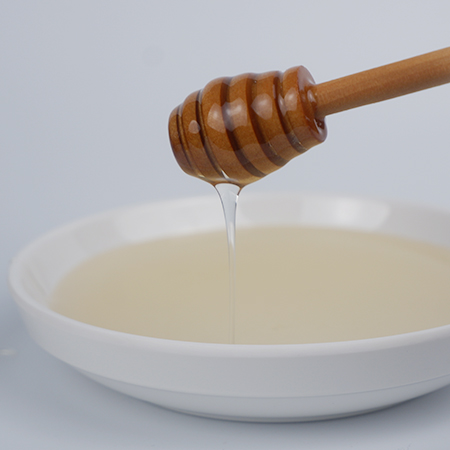
Acacia honey is also called locust honey or locust nectar. It is watery white or slightly yellow. The honey liquid is clear and transparent. It has a refreshing smell, just like the scent of acacia flowers. It has a fresh and clean taste. It is cool in nature, sweet but not greasy, and is not easy to crystallize or does not crystallize. If the crystallization is in the form of fine particles or oil, it is more transparent than other single flower honeys. When in liquid form, the honey noodles often have light foam.
Acacia, also known as Robinia pseudoacacia, is a deciduous tree of the Papilionaceae family. The nectaries of Robinia acacia are located at the base of the ovary. The corolla is deep and the petals are hard. When it first opens, bees cannot reach the nectar with their kisses. Until the flowers bloom and the petals soften, bees can collect large amounts of nectar. Robinia pseudoacacia secretes abundant nectar, has very little pollen, has a short nectar-flooding period, and has unstable yields.
Robinia pseudoacacia is mainly distributed in Shandong, Henan, and Hebei in my country, followed by Shaanxi, Liaoning, Jiangsu, Anhui, Shanxi, Gansu, Beijing, and Tianjin.
The first flowering period of black locust is late April south of the Yangtze River and early to mid-May north of the Yangtze River. The flowering period is short and concentrated, lasting about 10 days.





ANHUI HONEY ORIGIN BIOLOGICAL TECHNOLOGY CO., LTD. 版权所有 皖ICP备19018471号-1 Disclaimer